Have you ever booked somewhere that called itself eco-friendly, arrived, and found a single recycling bin as the extent of their environmental commitment?
The word eco gets used loosely in travel. And for travellers who actually care about where their money goes, that is frustrating.
Kangaroo Island is one of the most intact natural environments in Australia. And many of the stays here are genuinely built around sustainability rather than just marketing it.
The island sits about 13 kilometres off the Fleurieu Peninsula and covers around 4,400 square kilometres of beaches, bush, national park, and farmland.
This guide helps you find Kangaroo Island eco accommodation that is authentic, explains how to get there, and gives you a realistic picture of what to expect once you arrive.
What Does Eco Accommodation Actually Mean on Kangaroo Island?
The term gets stretched a lot but when we use it here, we mean accommodation experience focused on off-grid sustainability, minimal environmental footprint, and immersion in native wildlife. The real markers to look for include:
- Off-grid solar power systems, so the stay does not draw from the coal-heavy grid
- Rainwater collection for all household water needs
- Minimal building footprint, using the land as it is rather than clearing it
- Locally sourced food provisions from island producers
- Active conservation of the surrounding land, not just access to it
Properties that meet most of those criteria do exist on Kangaroo Island, and they are not hard to find once you know what to look for.
The best ones run entirely off-grid, provide locally sourced welcome provisions, and sit on land that is managed as a wildlife habitat.
One more thing worth noting:
Kangaroo Island spent 2019 and 2020 recovering from devastating bushfires.
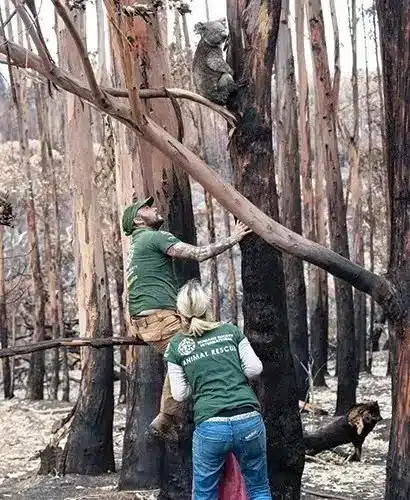
Image Source: Humane World for Animals | Conservationists rescue a koala affected by Australia’s 2020 wildfires on Kangaroo Island
It’s now been six to seven years since then. But many properties – including CABN’s – that rebuilt or opened since the bushfires did so with sustainability as a core design principle.
Did you know?
As part of its sustainable ecology awareness programme, CABN organises a guided koala walk and bush fire ecology tour for Kangaroo Island tourists and guests.
What Types of Eco Accommodation are Available on Kangaroo Island?
There are three broad styles:
Self-Contained Off-Grid Cabins
For couples or small groups who want privacy without needing anyone to organise things for them, self-contained off-grid cabins are the ideal format.
CABN X at Kangaroo Island is the standout in this category.
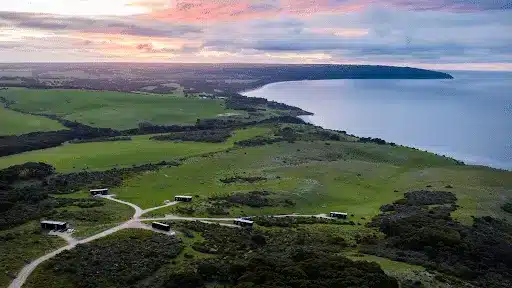
The CABN X cabins at Cape St Albans sit on 400 acres of private land, with direct views of Antechamber Bay and the surrounding coastline.
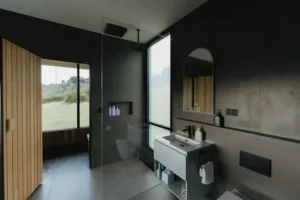
Each cabin runs on solar power, collects rainwater, and comes with a full kitchen, a private sauna with ocean views, an outdoor bath on the deck, and a skylight above the bed for star gazing.
Guests at CABN X Oceanview Kangaroo Island tend to say the same thing on the way out: arriving sceptical about how good it could really be, and leaving saying four days was not long enough.
- One of our guests, Vynette S., put it plainly after her September 2024 stay: “Two days is not long enough.”
- SMc, who spent four days there in May 2024, agreed: “4 days and nights was simply not long enough for me.”
- Tane L. also described kicking back on the deck watching the sun go down with kangaroos hopping about nearby.
- John and Anna found a welcome pack waiting on arrival with bacon, eggs, bread, butter, olives, and a bottle of wine. They called the location “absolutely amazing and tranquil.”
Hosted Eco Retreats
These are properties where the owners or managers are on-site and curate your experience.
- Ecopia Retreat near the centre of the island is one of the best examples. They run completely off-grid on solar and rainwater, and the land is a registered wildlife sanctuary covering over 60 hectares of native bushland.
- Oceanview Eco Villas is another option. It sits on a 500-acre coastal property and is fully hosted, meaning your hosts Tim and Tamsin are there to provide local knowledge, organise meals using local produce, and help you make the most of the island.
These are good options for travellers who appreciate guidance and want everything taken care of.
Eco-Lodge and Multi-Room Options
For groups or travellers who want more space, there are lodge-style eco properties that sleep four to ten guests.
Stowaway Kangaroo Island offers standalone retreats with hot tubs, saunas, and wood fires, positioned to give views of ocean, farmland, and bushland.
Southern Ocean Lodge, recently named among the world’s top hotels to watch for 2025, represents the high end of this category.
How Do You Get to Kangaroo Island?
This is one of the questions people ask most before visiting, and it is genuinely simpler than it seems.
Option 1: Ferry from Cape Jervis
SeaLink runs daily ferry crossings from Cape Jervis on the Fleurieu Peninsula to Penneshaw on Kangaroo Island. The crossing takes about 45 minutes. Cape Jervis is a 90-minute drive south of Adelaide. This is the most popular option and allows you to bring your own car, which is useful if you are staying somewhere remote.
Option 2: Fly from Adelaide
QantasLink operates daily flights from Adelaide Airport to Kangaroo Island Airport near Kingscote. The flight takes around 30 minutes. You can hire a car on arrival through Budget or Hertz, or arrange a private transfer through Kangaroo Island Transfers.
Note: most eco accommodation on Kangaroo Island is in genuinely remote areas. A few key tips before you go:
- Buy groceries in Penneshaw or Kingscote before heading to your property. The nearest shop to remote stays can be 20 to 30 minutes away.
- Some properties require driving on unsealed roads for 10 to 20 minutes. A standard vehicle handles this fine in dry conditions. Check with your property in advance if travelling in winter.
- Fill up with petrol before leaving the main towns. Bowsers are not common in remote parts of the island.
- Download offline maps before you leave phone range. Coverage is limited in the eastern and southern parts of the island.
What Wildlife Can You Expect at Eco Accommodation on Kangaroo Island?
Kangaroos and wallabies are often on the property at dawn and dusk. Echidnas move through the garden regularly. Koalas are visible in the native trees in many areas without needing to go anywhere specific.
Note: The wildlife at and around most eco-stays in Kangaroo Island is not managed. It is just there.
For the more dramatic wildlife experiences, day trips from your accommodation can include:
- Seal Bay Conservation Park near Vivonne Bay, where a colony of wild sea lions rests on the beach and rangers lead small group walks among them
- Flinders Chase National Park in the west, which has spectacular rock formations and is a stronghold for native animals
- Little penguin observation at dusk near Penneshaw, where you can watch penguins come ashore from the ocean at nightfall
- Cape Willoughby Lighthouse, just a short drive from CABN X Kangaroo Island, with stunning coastline views and a rich maritime history
The experience always feels like having the island to yourself. You may consider spending three days walking, fishing from the beach, watching the wildlife from the deck, and using the sauna each evening with panoramic coastal views.
Is Eco Accommodation on Kangaroo Island Worth the Price?
Kangaroo Island accommodation is not cheap.
But off-grid cabins like CABN X Oceanview in Cape St Alban, Kangaroo Island, start from around $595 per night. CABN X Coastline View Kangaroo Island is 50 AUD cheaper at $545 as of March 2026.
Hosted eco retreats can run higher depending on what is included. These prices are comparable to a city luxury hotel but the experience is categorically different.
What you are paying for:
- Total privacy, often on hundreds of acres with no other guests visible or audible
- Locally sourced welcome provisions and breakfast packs included in the rate
- Architecturally designed cabins with features like private saunas, outdoor baths, and skylights
- Direct access to wildlife, coastline, and national park without needing to book a tour
- The knowledge that the property is actively operating as a conservation site
The value becomes clear when you compare what you would spend on meals, tours, and parking in a city hotel at the same price point. Here, much of that and more is already built in:
https://youtu.be/gKDcxhFUb6s?si=ivZuobeQkE1RGs_-
Frequently Asked Questions
When is the best time to visit Kangaroo Island?
Autumn (March to May) is arguably the best season. The weather is mild, crowds are thin compared to summer, and the wildlife is active. Winter offers dramatic coastal scenery and much lower prices, but some properties run reduced services. Spring brings wildflowers and new wildlife activity. Summer is popular but book early as it fills fast.
Do you need a 4WD to reach remote eco accommodation?
Not always. Some properties like CABN X are accessed via unsealed roads but do not require a 4WD in normal conditions. Check with your specific property before travelling. If you are visiting in winter after heavy rain, a higher-clearance vehicle is advisable for some routes.
Can you do Kangaroo Island as a day trip, or do you need to stay overnight?
You can do a day trip but it is limiting. The ferry crossing alone takes 45 minutes each way, and the island is large. Most of the best experiences, including wildlife at dusk, stargazing, and the genuine quietness of the place, are only accessible if you stay overnight. Three to four nights is the ideal length for most eco stays.